The following is structured as a formal institutional research proposal for Crown Agarwood Processing Corp. (CAPC). It is designed for presentation to Philippine universities, biotechnology laboratories, forestry research institutions, and potential technology investors.
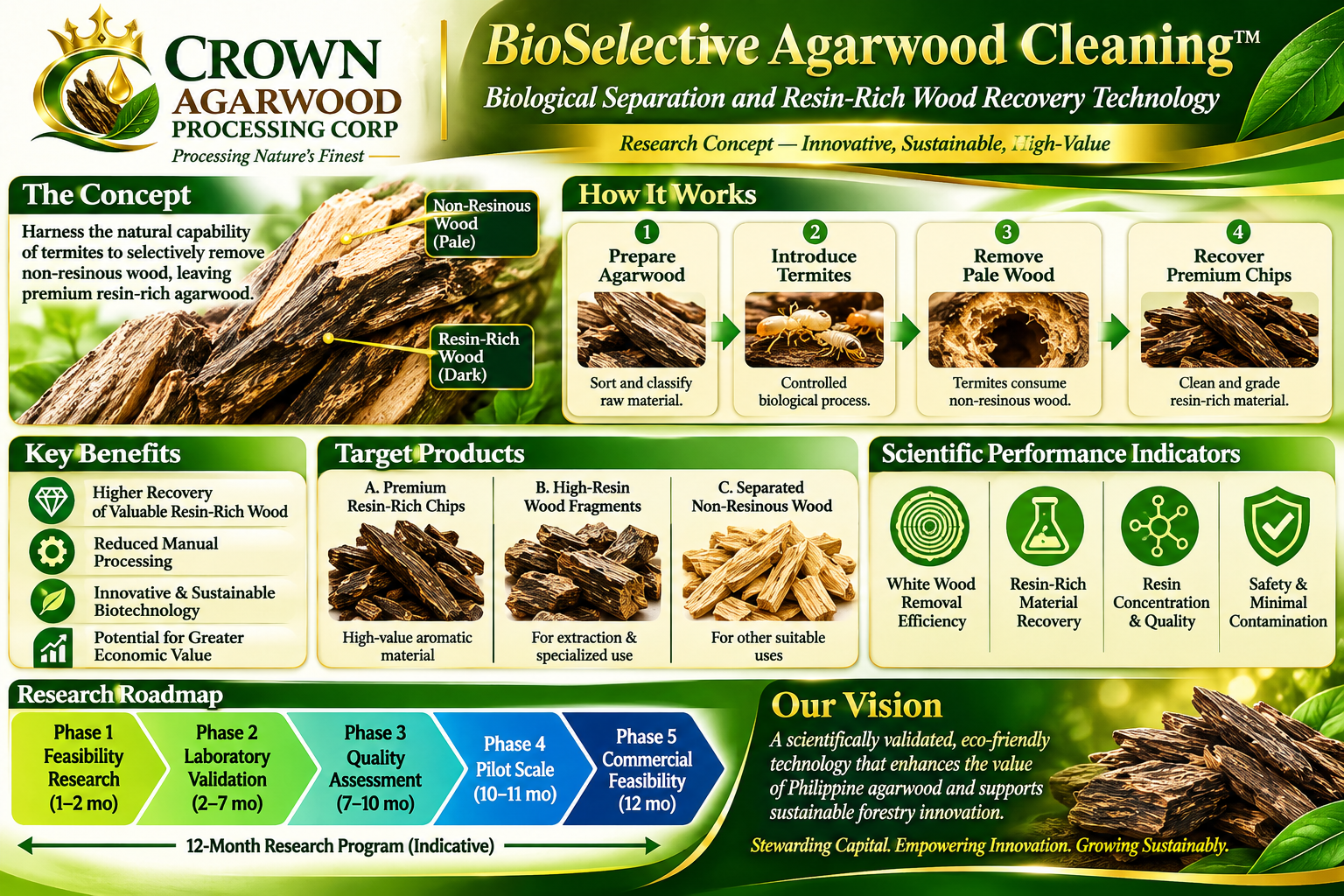
The proposal deliberately treats termite-assisted separation as an experimental hypothesis, not an established technology. Its central objective is to establish whether selective biological removal of non-resinous agarwood can be achieved without unacceptable damage, contamination, or loss of valuable resin-bearing material.
Institutional R&D Proposal
BIOSELECTIVE AGARWOOD CLEANING™
Biological Separation and Resin-Rich Wood Recovery Technology
Project Proponent: Crown Agarwood Processing Corp. (CAPC)
Project Classification: Applied Research, Biotechnology and Post-Harvest Processing
Research Status: Proposed – For Academic and Laboratory Collaboration
Proposed Research Location: Philippines
Document Purpose: University Partnership, Laboratory Collaboration and Technology Investment
FORMAL RESEARCH AND DEVELOPMENT PROJECT PROPOSAL
1. Executive Summary
Crown Agarwood Processing Corp. proposes to undertake an applied research and development project entitled BioSelective Agarwood Cleaning™, investigating the potential application of biological wood degradation for the selective removal of non-resinous wood from harvested agarwood.
Agarwood is a valuable aromatic wood formed in certain Aquilaria and other susceptible tree species through biological and physical stress responses. Harvested agarwood commonly contains a mixture of dark resin-bearing tissues and lighter-colored, relatively non-resinous wood.
Conventional post-harvest preparation involves manual carving, trimming, sorting and mechanical removal of unwanted wood. These operations can be labor-intensive and may result in the loss of valuable resin-bearing material.
This project proposes investigating selected termite species and their associated biological mechanisms to determine whether non-resinous wood can be preferentially removed while preserving resin-rich portions.
The research will combine entomology, wood science, microbiology, analytical chemistry, biotechnology and post-harvest engineering.
The intended outcome is a scientifically validated processing protocol, provided that experimental results demonstrate sufficient selectivity, material recovery, product safety and economic feasibility.
2. Background and Rationale
Agarwood has significant commercial applications in:
- Luxury perfumery and fragrance manufacturing.
- Traditional incense and specialty aromatic products.
- Essential oil and botanical extraction.
- Premium agarwood chips and wood fragments.
- High-value aromatic raw materials.
One of the challenges in agarwood processing is separating resin-rich wood from surrounding non-resinous material.
The appearance of dark coloration alone does not establish resin concentration or commercial grade. Consequently, processing methods should be supported by chemical analysis and physical quality assessment.
Termites are naturally occurring wood-feeding insects with specialized digestive systems and microbial symbiosis that enable them to degrade structural wood components.
This biological capability provides a research opportunity: investigating whether particular termite species exhibit differential feeding behavior toward non-resinous and resin-bearing agarwood tissues.
The proposed research does not assume that resin-rich wood is naturally protected from termite feeding. Instead, it seeks to establish whether measurable feeding selectivity exists and whether any observed selectivity can be used safely and economically.
3. General and Specific Objectives
General objective
To develop and evaluate a controlled biological separation technology for improving the recovery and preparation of resin-rich agarwood materials.
Specific objectives
- Identify and characterize candidate termite species.
- Determine feeding preferences between non-resinous and resin-bearing agarwood tissues.
- Investigate the influence of resin-related chemical composition on feeding behavior.
- Quantify the removal of non-resinous wood.
- Determine the degree of preservation of resin-bearing material.
- Assess possible microbial contamination and structural deterioration.
- Evaluate the aromatic and chemical quality of recovered materials.
- Develop a preliminary biological processing system.
- Determine commercial scalability and economic viability.
4. Research Hypothesis
The project will test the following hypotheses:
H1: Selected termite species may exhibit different feeding preferences between non-resinous and resin-bearing agarwood tissues.
H2: Resin-related chemical composition may influence termite feeding behavior and wood degradation.
H3: Biological separation may improve the proportion of recoverable resin-bearing material compared with conventional processing methods.
H4: A controlled biological processing system may be technically feasible without unacceptable deterioration of recovered agarwood quality.
The null hypothesis is that termite exposure does not produce a useful selective separation advantage over conventional processing.
5. Proposed Research Methodology
5.1 Research design
A controlled laboratory experimental design will be implemented using harvested agarwood samples from documented plantation sources.
The study will use matched wood samples classified according to their initial resin-bearing characteristics.
5.2 Experimental treatment groups
| Group | Experimental treatment | Purpose |
|---|---|---|
| T0 | Untreated agarwood | Baseline control |
| T1 | Termite exposure | Evaluate biological selectivity |
| T2 | Non-biological removal comparison | Assess alternative separation |
| T3 | Mechanical precision trimming | Establish conventional processing benchmark |
Independent biological replicates will be used, with sample numbers determined through preliminary variability assessment and statistical power analysis.
5.3 Biological agent identification
The collaborating entomology laboratory will:
- Identify candidate termite species.
- Document feeding behavior and ecological characteristics.
- Determine potential pest risks.
- Evaluate containment requirements.
- Assess whether candidate species can be safely studied under laboratory conditions.
Termite species will not be released into plantation environments.
5.4 Wood characterization
Before experimentation, samples will undergo:
- Visual and microscopic examination.
- Moisture-content determination.
- Initial weight measurement.
- Resin-bearing tissue classification.
- Chemical characterization of representative samples.
5.5 Biological separation assessment
The laboratory will evaluate:
- Total wood mass loss.
- Pale wood removal.
- Resin-bearing material loss.
- Feeding selectivity.
- Physical damage.
- Microbial contamination.
- Recoverable material quantity.
Termite exposure will be conducted only in approved, escape-proof research enclosures with documented biological containment and disposal procedures.
5.6 Chemical and quality analysis
Recovered agarwood will be evaluated using appropriate analytical techniques:
| Analytical method | Research application |
|---|---|
| GC-MS | Aromatic compound profiling |
| GC-MS/MS | Targeted chemical analysis |
| FTIR | Chemical functional-group characterization |
| Optical microscopy | Tissue and structural examination |
| Gravimetric analysis | Material recovery and mass balance |
| Moisture analysis | Product stability |
| Sensory evaluation | Comparative aroma assessment |
Chemical testing should include appropriate reference standards and validated analytical procedures.
6. Key Performance Indicators
The following indicators will determine whether the technology has research and commercial potential.
| KPI | Definition |
|---|---|
| White Wood Removal Efficiency | Fraction of initial non-resinous wood removed |
| Resin-Rich Material Recovery | Fraction of initial resin-bearing material retained |
| Selectivity Index | Ratio of non-resinous wood removal to resin-bearing wood loss |
| Chemical Quality Retention | Retention of selected aromatic chemical markers |
| Physical Integrity | Degree of structural preservation |
| Contamination Level | Biological and foreign-material contamination |
| Processing Economics | Cost per kilogram of recovered material |
A higher Selectivity Index is desirable, provided that the absolute resin-bearing material recovery remains commercially acceptable.
Importantly, the project will separately measure the chemical composition of recovered material. A higher percentage of dark wood does not automatically mean a higher intrinsic resin concentration.
7. Expected Research Outputs
The project is expected to produce the following deliverables:
- Candidate termite species identification report.
- Comparative termite feeding behavior assessment.
- Agarwood biological selectivity research report.
- Resin-rich wood recovery assessment.
- Chemical composition and aroma comparison.
- Microbial contamination and product safety assessment.
- Biological separation process feasibility report.
- Preliminary equipment and containment design.
- Commercial processing feasibility study.
- Validated biological processing protocol, if the evidence supports one.
8. Proposed Project Implementation Schedule
Indicative 12-month research schedule, subject to partner capacity and regulatory approvals.
| Research activity | Months |
|---|---|
| Literature review and protocol development | 1–2 |
| Termite identification and screening | 2–3 |
| Agarwood sample characterization | 2–4 |
| Controlled laboratory experiments | 4–7 |
| Material recovery and chemical testing | 7–9 |
| Data analysis and validation | 9–10 |
| Pilot feasibility and economic analysis | 10–11 |
| Final report and technology assessment | 12 |
9. Proposed Research Collaboration Structure
CAPC proposes establishing a collaborative research arrangement with a Philippine university, biotechnology laboratory or qualified research institution.
| Research partner | Proposed responsibility |
|---|---|
| CAPC | Project ownership, funding coordination, raw material supply and commercialization |
| University Entomology Department | Termite identification and biological behavior research |
| Forestry or Wood Science Department | Agarwood tissue characterization and wood properties |
| Biotechnology Laboratory | Microbial characterization and biological assessment |
| Chemistry Laboratory | GC-MS and other analytical testing |
| Engineering Department | Contained processing equipment and process optimization |
Potential institutions for exploratory collaboration include:
- University of the Philippines Los Baños – Forestry, entomology, wood science and biotechnology research.
- Forest Products Research and Development Institute (FPRDI) – Wood properties and forest-products processing.
- Ecosystems Research and Development Bureau (ERDB) – Forestry and ecosystem research.
- Department of Science and Technology – Research and development collaboration and applicable technology support.
Actual participation will be subject to institutional interest, technical capacity and formal agreements.
10. Regulatory and Biosafety Considerations
The research will comply with applicable Philippine laws, institutional biosafety requirements and environmental regulations.
Areas requiring review include:
- Termite species identification and potential invasive-pest risks.
- Appropriate permits for collecting, transporting or maintaining biological specimens.
- Containment, escape prevention and disposal.
- Legal sourcing and documentation of agarwood samples.
- Applicable DENR requirements for agarwood and forest products.
- CITES requirements where applicable to the species and movement of materials.
- Environmental and occupational health and safety requirements.
No live termite colony will be transported or released without the necessary approvals.
11. Proposed Research Budget Framework
A detailed budget will be finalized after consultation with the selected research institution.
| Budget component | Description |
|---|---|
| Research personnel | Entomologists, biotechnologists and research assistants |
| Biological screening | Termite identification and laboratory assessment |
| Laboratory facilities | Containment systems and experimental equipment |
| Agarwood materials | Sample sourcing, preparation and classification |
| Chemical analysis | GC-MS, FTIR and other testing |
| Microbial testing | Contamination and microbial characterization |
| Engineering | Prototype design and process monitoring |
| Documentation | Reports, intellectual property and dissemination |
| Contingency | Unforeseen research requirements |
Funding structure: To be negotiated between CAPC and the research partner.
12. Intellectual Property and Commercialization
CAPC proposes that the collaboration agreement establish clear ownership and licensing arrangements before research begins.
Potential intellectual property assets include:
- Biological separation methodologies.
- Selective feeding assessment systems.
- Controlled processing equipment.
- Material recovery and grading procedures.
- Analytical datasets and process optimization.
- Commercial applications and associated technical know-how.
Background intellectual property will remain with its respective owner. Ownership of newly developed inventions, patent rights, research publications, confidential information and commercialization rights will be governed by the research agreement.
Commercial deployment will be considered only after successful technical and safety validation.
13. Commercialization Potential
If successfully validated, BioSelective Agarwood Cleaning™ could complement CAPC’s post-harvest processing and botanical extraction operations.
Potential commercial applications include:
- Premium agarwood chip preparation.
- Resin-rich raw material recovery.
- Preparation of agarwood materials for extraction.
- Improved post-harvest material classification.
- Development of proprietary agarwood processing technology.
The technology may offer a differentiated processing capability, but its economic value will depend on recovery yield, processing time, contamination control and comparison against manual and mechanical alternatives.
14. Project Risk Assessment
| Risk | Proposed mitigation |
|---|---|
| No selective feeding preference | Establish early experimental termination criteria |
| Damage to resin-rich wood | Monitor material loss and physical integrity |
| Termite escape | Use approved containment systems |
| Microbial contamination | Conduct microbiological testing and validated cleaning |
| Inconsistent results | Standardize samples and use independent replication |
| Poor commercial economics | Compare with manual and mechanical benchmarks |
| Regulatory restrictions | Secure institutional and regulatory review before experiments |
15. Conclusion
BioSelective Agarwood Cleaning™ represents an exploratory biotechnology approach to improving harvested agarwood preparation.
By investigating the biological capabilities of selected termite species, CAPC seeks to determine whether biological wood degradation can provide a selective, safe and economically viable method of separating non-resinous wood from valuable resin-bearing tissues.
The proposed research offers an opportunity for collaboration among forestry scientists, entomologists, microbiologists, analytical chemists and post-harvest processing specialists.
CAPC invites qualified academic and research institutions to participate in evaluating the scientific feasibility of this technology and developing a potential future application for the Philippine agarwood industry.
16. Formal Partnership Invitation
RESEARCH COLLABORATION INVITATION
BioSelective Agarwood Cleaning™
Biological Separation and Resin-Rich Wood Recovery Technology
From: Crown Agarwood Processing Corp. (CAPC)
Subject: Invitation for University and Biotechnology Research Collaboration
Dear Research Director / University President / Laboratory Head,
Crown Agarwood Processing Corp. (CAPC) is pleased to introduce its proposed research and development initiative, BioSelective Agarwood Cleaning™, an exploratory biotechnology project focused on biological separation and resin-rich wood recovery from harvested agarwood.
The proposed research will investigate whether selected termite species can preferentially remove non-resinous wood surrounding resin-bearing agarwood tissues while preserving valuable aromatic wood materials.
The project aims to integrate entomology, forestry science, microbiology, analytical chemistry and post-harvest processing technology.
CAPC is seeking a qualified academic or research partner to collaborate in:
- Termite species identification and biological screening.
- Controlled laboratory feeding selectivity experiments.
- Agarwood tissue and resin characterization.
- Chemical and microbial analysis.
- Development of a preliminary biological separation process.
- Technical feasibility and commercialization assessment.
We believe this initiative presents an opportunity to explore a novel approach to Philippine agarwood processing and contribute to the development of science-based, value-added forestry technologies.
We would welcome the opportunity to discuss a potential research partnership, including technical responsibilities, laboratory facilities, funding arrangements and intellectual property agreements.
We look forward to exploring this collaboration.
Respectfully,
CROWN AGARWOOD PROCESSING CORP. (CAPC)
Authorized Representative
Corporate Management
Philippines
Stewarding Capital. Empowering Innovation. Growing Sustainably.
17. Recommended CAPC presentation identity
BioSelective Agarwood Cleaning™
CAPC BIOTECHNOLOGY & POST-HARVEST INNOVATION
Biological Separation. Resin Recovery. Processing Innovation.
Proposed institutional document package
- Research Project Proposal
- University Collaboration Letter
- Laboratory Experimental Protocol
- Preliminary Research Budget
- Intellectual Property Framework
- Investor Technology Brief
My recommendation for CAPC: Approach UPLB and FPRDI first for technical evaluation, particularly because this project requires both termite biology expertise and wood-processing science. Establish a small laboratory feasibility study before investing in a dedicated biological processing facility.
The most important milestone is demonstrating that the biological process can outperform conventional trimming in recoverable resin-bearing material, without compromising quality or safety.