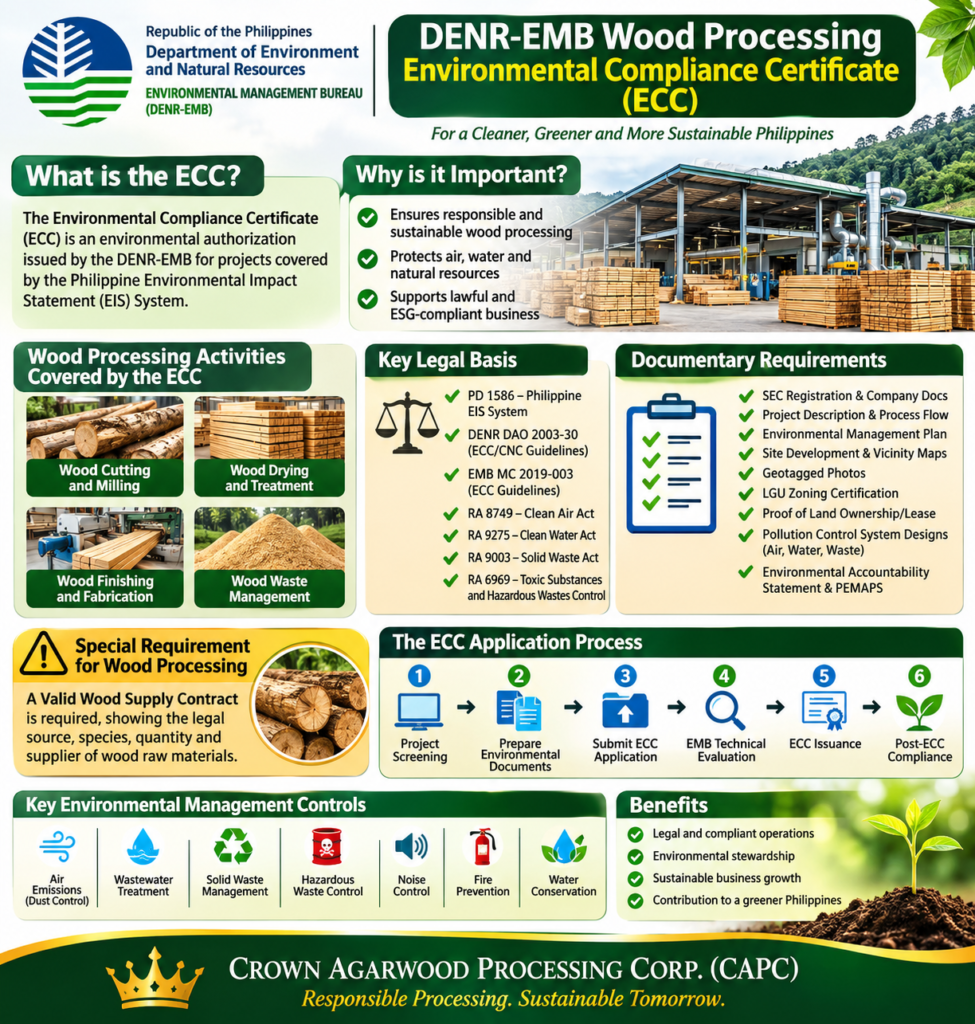
The Environmental Compliance Certificate (ECC) is an environmental authorization issued by the Philippine Department of Environment and Natural Resources – Environmental Management Bureau (DENR-EMB) for projects covered by the Philippine Environmental Impact Statement (EIS) System.
For a wood processing facility operated by Crown Agarwood Processing Corp. (CAPC), the ECC assessment should cover the proposed processing activities, facility capacity, site location, environmental impacts, pollution-control measures, and waste management systems.
Important: An ECC is not automatically required for every wood-processing operation. DENR-EMB determines the applicable environmental document and approval based on the project’s classification, scale, location, and environmental sensitivity.
1. Applicable environmental regulations
| Legal / regulatory reference | Relevance |
|---|---|
| Presidential Decree No. 1586 | Establishes the Philippine EIS System |
| DENR DAO 2003-30 | Implementing rules and procedures for ECC/CNC |
| EMB MC 2014-005 | Coverage screening and standardized requirements |
| EMB MC 2019-003 | Updated ECC processing guidelines for Category B projects |
| RA 8749 | Philippine Clean Air Act |
| RA 9275 | Philippine Clean Water Act |
| RA 9003 | Ecological Solid Waste Management Act |
| RA 6969 | Toxic Substances and Hazardous and Nuclear Wastes Control Act |
Wood manufacturing and processing are identified in DENR’s EIA procedural guidance as industrial activities requiring environmental assessment. The actual ECC requirement and assessment document depend on the project’s screening classification. DAO 30.doc+3
2. Wood processing activities covered by the assessment
A. Wood cutting and milling
Sawing, trimming, debarking, sizing, chipping and lumber preparation.
B. Wood drying and treatment
Kiln drying, preservation, conditioning and treatment processes.
C. Wood finishing and fabrication
Sanding, shaping, polishing, coating and product fabrication.
D. Wood waste management
Sawdust, wood chips, bark, offcuts and other processing residues.
3. Documentary requirements for ECC application
The following is a practical preparation checklist. EMB may require additional documents depending on the project classification.
| Requirement | Purpose |
|---|---|
| SEC registration and company documents | Identify the project proponent |
| Project Description | Describe the facility and operations |
| Environmental Management Plan | Identify mitigation measures |
| Project components and process flow | Explain the manufacturing process |
| Site development and vicinity maps | Establish facility location |
| Geotagged site photographs | Document site conditions |
| LGU zoning/land-use compatibility certification | Confirm land-use suitability |
| Proof of land ownership or lease | Establish authority over the site |
| Water pollution control system design | Address wastewater |
| Air pollution control system design | Address dust, smoke and emissions |
| Solid and hazardous waste management plan | Address industrial waste |
| Environmental accountability statement | Establish proponent accountability |
| PEMAPS questionnaire | Environmental monitoring prioritization |
These documents are consistent with EMB’s published ECC application requirements. Environmental Management Bureau Region 1+2
4. Special requirement: Valid wood supply contract
Important for wood processing
DENR-EMB regional guidance identifies a valid Wood Supply Contract as an additional requirement for wood processing projects.
The applicant should prepare supporting documentation showing:
- Legal source of timber or wood raw materials.
- Supplier identity and registration, where applicable.
- Wood species and quantities.
- Supply agreement or purchase contract.
- Applicable DENR transport and source documentation.
- Compliance with applicable forestry and wildlife regulations.
For agarwood processing, maintain records of plantation origin, species, tree registration where applicable, harvesting authorization, and legal transport documentation. EMB-XI+1
5. Environmental management systems
| Environmental aspect | Recommended facility controls |
|---|---|
| Air emissions | Dust collectors, ventilation and appropriate filtration |
| Wastewater | Proper drainage and wastewater treatment |
| Solid waste | Segregation, recycling and authorized disposal |
| Hazardous waste | Proper storage, labeling and accredited disposal |
| Noise | Equipment enclosures and noise monitoring |
| Fire prevention | Fire detection, extinguishers and safe storage |
| Water consumption | Water conservation and monitoring |
6. DENR-EMB application process
- Project screeningDetermine whether the facility is covered by the EIS System through the EMB screening process.
- Prepare environmental documentsPrepare the applicable EIS, IEE Checklist, EPRMP or other required document.
- Submit ECC applicationApply through the EMB online application system and submit supporting documents.
- EMB technical evaluationRespond to technical clarifications, inspections and additional requirements.
- ECC issuanceReceive the environmental approval with project-specific conditions and commitments.
- Post-ECC complianceImplement environmental safeguards and submit applicable Compliance Monitoring Reports.
Official resources:
7. Recommended ECC preparation for Crown Agarwood Processing Corp. (CAPC)
For CAPC, I recommend preparing an integrated environmental compliance package covering:
- Agarwood and other botanical raw material preparation.
- Wood cutting, sizing and processing.
- Wood drying and storage.
- Biomass and wood waste management.
- Supercritical CO₂ extraction.
- Steam and hydro-distillation.
- Essential oil and botanical extract production.
- Wastewater, air emissions and hazardous waste management.
The ECC must accurately describe the actual proposed facility. If extraction and processing are separate project components, they should be disclosed in the project description and assessed together where applicable.