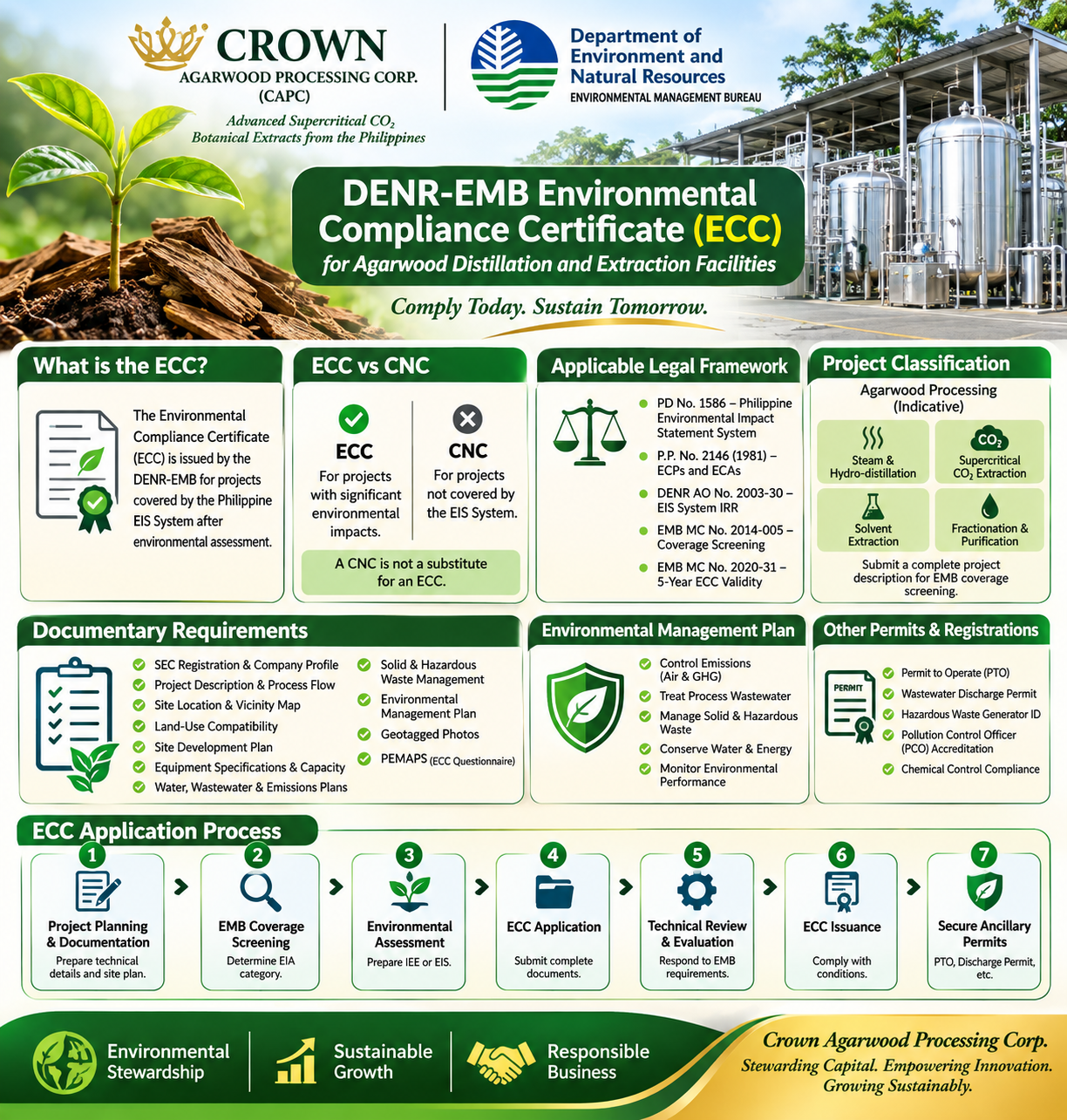
An Environmental Compliance Certificate (ECC) may be required when establishing or operating a facility for agarwood distillation, essential oil extraction, botanical extraction, and related processing activities, depending on the project’s environmental impact classification and location.
The ECC is issued by the Department of Environment and Natural Resources – Environmental Management Bureau (DENR-EMB) following the applicable Environmental Impact Assessment (EIA) process.
1. ECC versus CNC
It is important to distinguish these two environmental documents:
| Document | Purpose |
|---|---|
| Environmental Compliance Certificate (ECC) | Issued for projects covered by the Philippine EIS System after environmental assessment |
| Certificate of Non-Coverage (CNC) | Issued when a project is determined not to be covered by the EIS System |
Important: A CNC is not a substitute for an ECC when the project is classified as environmentally critical or located in an environmentally critical area and requires an ECC.
2. Applicable Philippine legal framework
The principal regulatory references are:
- Presidential Decree No. 1586 – Establishes the Philippine Environmental Impact Statement System.
- Presidential Proclamation No. 2146 (1981) – Identifies Environmentally Critical Projects (ECPs) and Environmentally Critical Areas (ECAs).
- DENR Administrative Order No. 2003-30 – Implementing Rules and Regulations of the Philippine EIS System.
- EMB Memorandum Circular No. 2014-005 – Guidelines for coverage screening and standardized requirements.
- EMB Memorandum Circular No. 2020-31 – Guidelines on the five-year validity of ECCs.
The EMB determines whether a project falls under Category A, B, C or D. A new facility’s technology, scale, location and environmental impacts are relevant to this determination. DAO 30.doc+3
3. Proposed project classification: Agarwood distillation and extraction
For an agarwood processing facility, the following activities should be disclosed in the Project Description Report.
A. Steam and hydro-distillation
- Agarwood chips and powder preparation
- Steam generation and boiler operation
- Hydro-distillation
- Essential oil and hydrosol collection
- Condensation and cooling systems
B. Supercritical CO₂ extraction
- CO₂ extraction equipment
- High-pressure processing
- CO₂ recovery and recycling
- Extract separation and collection
- Pressure and safety management
C. Solvent-based extraction
- Botanical material extraction
- Solvent handling and storage
- Solvent recovery
- Filtration and purification
- Residual solvent management
D. Fractionation and purification
- Aroma fractionation
- Oil purification
- Concentration
- Filtration
- Finished extract packaging
Initial regulatory assessment: These processes should be submitted together in a complete project description, including their individual capacities and utilities. It would be premature to declare the facility Category A, B, C or D without EMB coverage screening.
4. Documentary requirements for ECC application
The following is a practical preparation checklist. EMB may require additional documents depending on the assigned category and assessment procedure.
| Requirement | Description |
|---|---|
| SEC registration | Corporate registration and company details |
| Project Description | Detailed description of processing activities |
| Project location | Site address, coordinates and vicinity map |
| Land-use compatibility | LGU zoning or locational certification |
| Proof of site authority | Land title or lease agreement |
| Site development plan | Facility layout signed by qualified professionals |
| Process flow diagram | Distillation and extraction process |
| Equipment specifications | Capacity, power, fuel and operating hours |
| Water requirements | Source and estimated consumption |
| Wastewater management | Wastewater treatment and disposal plan |
| Air emissions | Boiler emissions and air pollution controls |
| Solid waste management | Biomass, spent material and general waste |
| Hazardous waste management | Used oil, solvents and other regulated wastes |
| Environmental Management Plan | Mitigation and monitoring measures |
| Geotagged photographs | Recent photographs of the proposed site |
| PEMAPS | Project Environmental Monitoring and Audit Prioritization Scheme questionnaire |
These are consistent with EMB’s published ECC application requirements, subject to the applicable project category. Environmental Management Bureau
5. Other environmental permits and registrations
An ECC does not replace the facility’s other environmental permits.
| Permit / Registration | When applicable |
|---|---|
| Permit to Operate (PTO) | Boiler, furnace, generator and other regulated air pollution sources |
| Wastewater Discharge Permit | When wastewater is discharged into a receiving water body or through a regulated discharge |
| Hazardous Waste Generator ID | When the facility generates regulated hazardous waste |
| Pollution Control Officer (PCO) Accreditation | When required based on the establishment’s pollution-generating activities |
| Chemical Control Order compliance | When regulated chemicals are handled |
| Permit to Transport Hazardous Waste | When regulated hazardous waste is transported |
The EMB CALABARZON 2026 Citizens Charter provides the regional permitting procedures for these requirements. EMB CALABARZON+4
6. Recommended ECC application process for CAPC
- Project planning and documentationPrepare the proposed facility’s technical description, process flow, equipment specifications, production capacity and site development plan.
- EMB coverage screeningSubmit the project description to DENR-EMB CALABARZON to determine the applicable EIA category and documentary requirements.
- Environmental assessmentPrepare the required IEE Checklist, EIS or other applicable environmental assessment documentation.
- ECC applicationSubmit the complete application and supporting documents through the applicable EMB process.
- Technical review and evaluationRespond to EMB requests for additional information, inspections or environmental assessment.
- ECC issuanceSecure the ECC and comply with its environmental conditions and approved Environmental Management Plan.
- Ancillary permitsSecure applicable PTO, Discharge Permit, hazardous waste registration and PCO accreditation before commencing the relevant regulated operations.
Official application references:
- DENR-EMB Environmental Impact Assessment Portal
- DENR-EMB CALABARZON
- EMB Online Permitting and Monitoring System
7. Proposed environmental management plan
For an agarwood extraction facility, I recommend incorporating these environmental safeguards into the project design:
| Environmental aspect | Proposed control |
|---|---|
| Boiler emissions | Appropriate air pollution control equipment |
| Process wastewater | Wastewater collection and treatment |
| Spent agarwood biomass | Segregation and appropriate reuse or disposal |
| Solvent emissions | Closed-loop extraction and solvent recovery |
| CO₂ extraction | Closed-loop CO₂ recovery and pressure safety systems |
| Hazardous chemicals | Proper storage, labeling and spill containment |
| Noise | Equipment enclosure and noise control |
| Water consumption | Water conservation and recycling |
| Environmental monitoring | Regular monitoring and compliance reporting |